
Patient & Provider Narratives · Springer
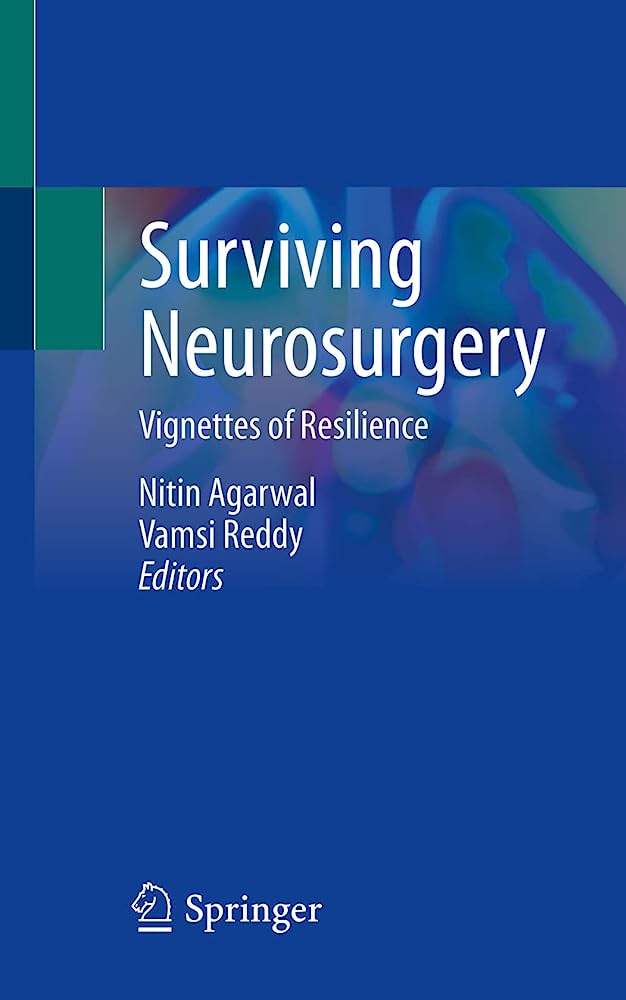
Surviving Neurosurgery
Vignettes of Resilience
First-person stories from patients, families, and clinicians who have lived through the most difficult diagnoses in neurosurgery, assembled into a single volume that pairs the human experience of disease with the medical context surrounding it.
Editors
- Nitin Agarwal, M.D., F.A.C.S.
- Vamsi Reddy, M.D.
Publisher
Springer
Format
Narrative vignettes
ISBN-10
3030869164
About the book
Surviving Neurosurgery: Vignettes of Resilience turns the usual textbook structure inside out. Rather than leading with anatomy or technique, each chapter opens with the lived experience of a person, a patient, a family member, a trainee, a surgeon, who has been on either side of a neurosurgical diagnosis.
The vignettes span the full breadth of the field: brain tumors, stroke and aneurysm, traumatic injury, spinal disease, and the long recoveries that follow. Each is paired with the medical and surgical context needed to understand what was happening underneath the story, giving readers a rare view of disease from both the inside and the outside of the operating room.
The result is a humanistic companion to the technical literature, a reminder that resilience, communication, and uncertainty sit at the center of neurosurgical care alongside the imaging and the instruments.
What's inside
First-person narratives
Vignettes written by the people who lived them: patients, families, and the clinicians who cared for them.
Cranial pathology
Stories of brain tumors, stroke, aneurysm, and traumatic brain injury, each set against the medical context of the case.
Spine & peripheral nerve
Accounts of degenerative, traumatic, and oncologic disease, and the long arc of recovery and rehabilitation that follows surgery.
The clinician's view
Reflections from residents, attendings, and the wider care team on the cases that shaped how they practice.
Medical context
Each story is anchored to the underlying diagnosis, workup, and treatment so readers leave with both the human and the clinical picture.
Resilience as the through-line
How patients and families adapt, recover, and rebuild after some of medicine's most catastrophic diagnoses.
Who it's for
-
Patients and families facing a new neurosurgical diagnosis who want to read what the road ahead has looked like for others.
-
Residents and trainees building empathy and communication skills alongside their operative training.
-
Medical students considering neurosurgery who want an honest look at the emotional landscape of the field.
-
Practicing clinicians in neurosurgery, neurology, and the neuro-ICU looking for perspective from the other side of the chart.
Get the book
Available in print and digital editions through Springer and major booksellers.